AI Chatbot for Car Service Businesses: How to Turn Website Visitors Into More Service Requests
A practical guide for car service businesses that want to use an AI website assistant to answer customer questions, collect service requests and turn website traffic into qualified leads.

A car service business website often gets visitors who already have a problem and want a quick answer. They may need diagnostics, routine maintenance, brake repair, engine work, tire service, or help understanding whether a problem is urgent.
The challenge is that many visitors leave without calling or submitting a useful inquiry. They browse for a minute, do not find a fast answer, and move on to another repair shop.
A practical comparison is AI Chatbot for Restaurants.
An AI chatbot for car service businesses can help by answering common questions, collecting lead details and guiding visitors toward a clear next step. It does not need to replace staff or mechanics. Its main job is to turn website traffic into structured service requests that are easier to handle.

Why car service businesses lose website leads
Auto repair and car service websites often attract visitors with immediate intent. A person may already have a warning light on, strange engine noise, brake issue, or simply need a service appointment soon.
Typical visitor questions include:
- Do you work with my vehicle brand?
- Can I book diagnostics?
- Do you do brake repair?
- Do you offer oil changes?
- How quickly can I get an appointment?
- Where are you located?
- Are you open on Saturday?
- Can I bring the car in today?
- Do you work with fleet vehicles?
- Can you inspect the issue before quoting?
A normal contact form is often too weak for this. The visitor may not know what to write. A phone call may not be convenient. If the site does not give a fast path forward, the user leaves.
This idea also relates to AI Assistant vs Live Chat.
That is where a website assistant becomes useful. It lets the visitor ask a direct question, get a helpful answer, and leave enough information for the service business to follow up.
What a car service AI chatbot should do
A good chatbot for an auto repair or car service business should focus on practical first-contact tasks.
Useful tasks include:
- answering common service questions
- collecting repair or maintenance requests
- qualifying diagnostics requests
- collecting appointment details
- explaining what happens next
- sending inquiries to the business by email or internal workflow
- helping identify urgent vs non-urgent requests
The assistant should not try to diagnose every technical issue with certainty. Its job is to guide the conversation, collect the right details, and help the customer move toward booking or contact.
Common use cases for car service businesses
The most useful chatbot workflows usually involve one of these situations:
Routine maintenance requests
Many visitors are looking for oil changes, filter replacement, battery checks, tire service, or scheduled maintenance. The chatbot can collect the type of service, vehicle model, preferred day, and contact information.
Diagnostics inquiries
Some visitors do not know the exact repair they need. They only know that something feels wrong. The assistant can collect a short issue description, warning lights, strange sounds, or other symptoms and pass the inquiry to the service team.
Repair requests
Customers may be looking for help with brakes, suspension, engine issues, transmission questions, air conditioning, electrical problems, or other repairs. A chatbot can guide them toward a structured request instead of a vague message.
Urgent problems
If the visitor says the car is not starting, overheating, or unsafe to drive, the assistant can identify the request as urgent and guide the visitor toward the right next step, such as immediate contact.
Fleet or business vehicles
Some service shops work with company vehicles or fleets. The assistant can collect the business name, number of vehicles, issue type and contact information.
What questions the chatbot should answer
A car service chatbot should be prepared to answer common questions that help the visitor decide whether to contact the business.
Examples include:
- service categories
- opening hours
- location
- vehicle types or brands accepted
- booking process
- whether diagnostics are available
- whether same-day or next-day appointments are possible
- what information the customer should prepare
- whether the business handles urgent cases
- basic explanations of how the service request process works
The important part is that the assistant should only answer from information the business actually provides. It should not invent repair promises, guaranteed turnaround times or exact prices when those are unknown.
What customer details should be collected
The assistant should collect enough information for a useful follow-up, but it should not feel like a long form.
For a normal service request, the chatbot can collect:
- customer name
- phone number
- email if needed
- vehicle make and model
- service needed or issue description
- preferred appointment date
- preferred appointment time
- whether the issue is urgent
- short message or additional details
For a diagnostics or repair request, it can also ask:
- warning lights visible
- unusual sounds or symptoms
- whether the vehicle is drivable
- when the problem started
- whether the customer has visited before
The goal is not to ask everything. The goal is to collect enough context so the service business can respond faster and more accurately.
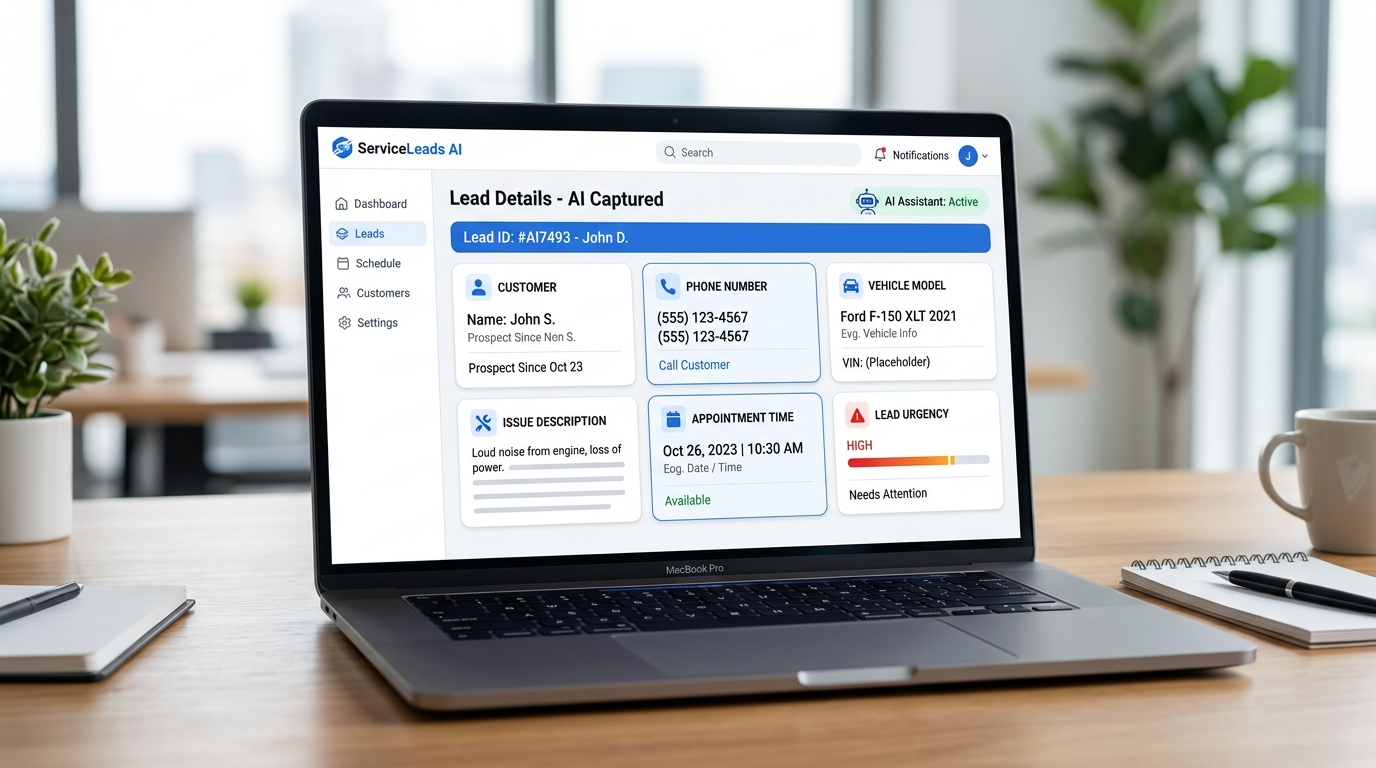
How a chatbot improves lead quality
A vague contact form submission might say:
“I need help with my car. Please call me.”
That is not very helpful.
A chatbot can turn that into something much better:
- Name: Daniel
- Phone: +1 555 222 7788
- Vehicle: 2017 Ford Focus
- Issue: check engine light and rough idle
- Preferred visit: tomorrow morning
- Urgency: drivable, but wants inspection soon
- Message: issue started two days ago
This gives the repair shop something real to work with. Staff can reply faster, prepare better, and reduce back-and-forth questions.
That is the real value: turning unclear intent into structured service leads.
Where the lead should go
For many small and mid-sized service businesses, email delivery is enough. The important thing is that the inquiry arrives cleanly and clearly.
A typical lead could be sent like this:
New car service inquiry
- Customer: Daniel
- Phone: +1 555 222 7788
- Vehicle: 2017 Ford Focus
- Request: diagnostics
- Issue: check engine light and rough idle
- Preferred date: tomorrow
- Preferred time: morning
- Urgency: normal
- Message: wants inspection soon
For a broader workflow explanation, see the guide on website chatbot lead generation.
Chatbot vs standard contact form
A contact form waits for the visitor to know exactly what to submit.
A chatbot helps guide the request step by step.
That matters for car service businesses because many visitors are unsure how to describe the issue. They may only know that “the brakes feel strange” or “the engine sounds different.” A chatbot can ask smart follow-up questions and turn that into a more useful inquiry.
This reduces weak leads and makes the website more practical.
Where to place the AI assistant on the site
A car service chatbot is useful on pages where visitors are most likely to have action intent.
Good placements include:
- the homepage
- service pages
- diagnostics pages
- appointment or booking pages
- contact pages
- mobile website view
A good opening message could be:
“Hi. I can help with service questions, repair inquiries, diagnostics, or appointment requests. What would you like help with?”
That feels more useful than a passive form.
Common mistakes
A chatbot for a car service business works best when it stays practical and controlled.
Mistake 1: promising exact prices too early
Repair work often depends on diagnostics or inspection. The chatbot should not promise exact prices unless the business has clear rules for it.
Mistake 2: pretending to fully diagnose the issue
The assistant can help classify and collect the issue, but it should not pretend to replace a mechanic.
Mistake 3: asking too many questions
Visitors want a quick path. If the assistant asks too much too early, people drop off.
Mistake 4: ignoring urgency
Some problems are routine, others are urgent. The chatbot should help distinguish between them.
Mistake 5: using generic business language
The assistant should sound like it belongs to a car service business. It should understand maintenance, repairs, diagnostics, appointments and customer concerns.
When this works best
An AI assistant is especially useful for car service businesses that:
- get steady website traffic
- lose visitors before contact
- want more structured service requests
- want faster follow-up
- offer multiple services
- receive many repeated questions
- need a better way to collect diagnostic and appointment leads
The same type of workflow can also help other industries. For example, beauty salons can use it to collect appointment requests, dental clinics can use it for patient inquiries, and law firms can use it for consultation requests.
What to prepare before adding a chatbot
Before using an AI assistant on a car service website, prepare the information it should know.
Useful inputs include:
- service categories
- accepted vehicle brands or types
- opening hours
- address
- phone number
- booking rules
- diagnostics policy
- urgent case instructions
- common questions
- preferred lead delivery email
- what the assistant should never promise
This makes the assistant more useful and more reliable.

How Selvanto fits this workflow
If you want to understand how this type of website assistant can be implemented in practice, start with Selvanto.
The idea is simple: the assistant appears on the website, answers visitor questions, collects useful lead details and sends the request to the business.
You can also visit Selvanto.com or open the Selvanto demo to see the main product and how an AI assistant can work as a lead capture layer for business websites.
Final thoughts
A chatbot for a car service business should not be treated like a generic chat window. Its value comes from helping real customers take the next step.
The best version answers common questions, qualifies the request, collects the right details and sends structured leads to the business. That helps reduce missed opportunities and makes website traffic more useful.
For auto repair and car service companies, the goal is not to automate the workshop. The goal is to make the first website interaction easier for the customer and more actionable for the business.
FAQ
Can an AI chatbot collect service requests for a car service business?
Yes. It can collect the customer name, phone number, vehicle issue, preferred appointment time and other useful details before sending the request to the business.
What questions can a car service chatbot answer?
It can answer common questions about services, opening hours, location, booking process, diagnostics, maintenance, and basic repair workflow if that information is provided.
Should a chatbot provide exact repair quotes?
Not unless the business has a clear rule-based quoting system. In most cases, the chatbot should explain that final pricing depends on inspection or diagnostics.
Can an AI assistant help collect emergency or urgent repair requests?
Yes. It can identify urgent issues, collect contact details, and guide the customer toward the next step, such as calling or submitting a priority request.
What is the main value of a chatbot for auto repair businesses?
Its main value is turning undecided website visitors into structured service leads with enough detail for the business to respond quickly.
Next step
If you want to understand how this workflow can be implemented on a real business website, continue with the internal Selvanto page.
Read about Selvanto