AI Assistant vs. Live Chat: Which is Better for Small Business Websites?
Compare AI website assistants and traditional live chat for local businesses. Discover which solution captures more leads and requires less staff time.

Adding a chat widget to your business website is one of the smartest marketing moves you can make. It invites conversation, reduces friction, and gives potential customers a fast way to get answers. But when it comes time to choose the actual technology behind that chat widget, local business owners face a critical decision: should you use a traditional Live Chat operated by a human, or an automated AI Website Assistant?
A few years ago, traditional live chat was the only reliable option. Today, AI assistants have completely transformed how local businesses interact with their website traffic.
This point also connects with AI Chatbot for Cleaning Services.
In this comprehensive comparison, we will break down the pros, cons, and hidden costs of both approaches to help you decide which solution will generate the most leads for your specific business.
The Promise vs. The Reality of Traditional Live Chat
Traditional live chat platforms are built on a simple premise: when a visitor lands on your website and has a question, a friendly chat bubble pops up. The visitor types their question, and a human agent on the other side types a response in real-time.
When it works perfectly, it is a great experience. But for 90% of local businesses, the reality of live chat is very different from the promise.
The Staffing Bottleneck
Live chat requires exactly that: a live human. If you own a car service business, you are likely under the hood of a car or managing the front desk. If you run a dental clinic, you are with patients. You cannot sit staring at a chat dashboard waiting for a website visitor to say “Hello.”
A good companion guide is Website Chatbots & Lead Gen.
Because local businesses rarely have a dedicated 24/7 support team, live chat widgets usually end up completely abandoned.
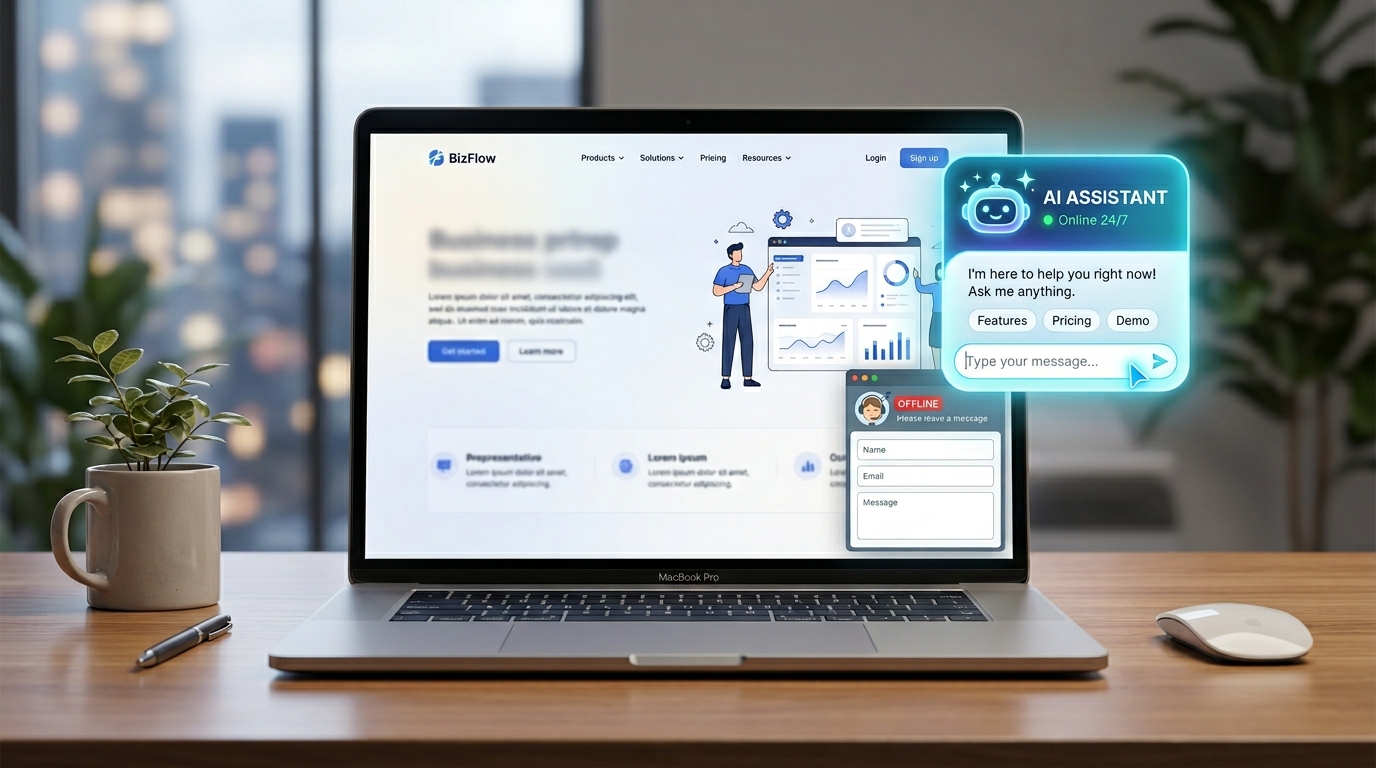
The “We Are Offline” Problem
What happens when you cannot answer a live chat within 30 seconds? The visitor leaves. In today’s fast-paced digital world, people expect instant gratification.
Worse, to avoid missing messages, many businesses set their live chat to “Offline Mode,” which essentially turns the chat widget into a glorified, clunky email contact form. A message pops up saying: “We are currently offline. Please leave your email and we will get back to you.” This completely defeats the purpose of conversational marketing.
How AI Assistants Change the Game
An AI website assistant solves the core problem of live chat: it completely removes the human staffing bottleneck while still providing an interactive, conversational experience for the website visitor.
Instead of routing messages to an empty dashboard, the AI acts as your dedicated digital receptionist. It is trained on your business information—your opening hours, your services, your location, and your booking policies.
Instant Responses, 24/7
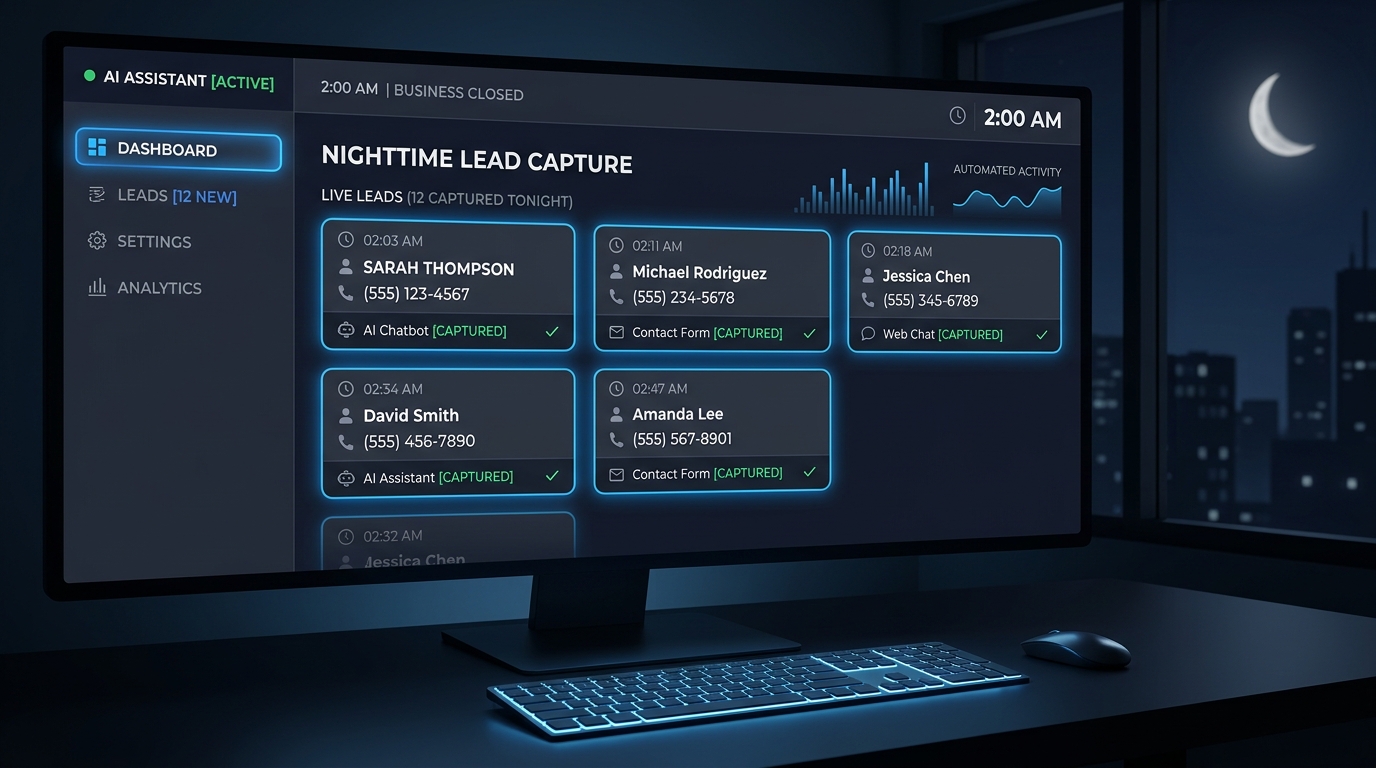
An AI assistant never sleeps. Whether a visitor is trying to book a beauty salon appointment at 11:30 PM on a Sunday, or asking about a menu at 6:00 AM before your restaurant opens, the AI is there to answer immediately.
Automated Lead Qualification
While live chat depends on a human agent remembering to ask for an email address or phone number, an AI assistant is systematically programmed to capture leads. After answering a visitor’s question, it seamlessly pivots the conversation: “I can help schedule that for you. What is the best phone number for our team to call you back on?”
For a deeper dive into how this process works, you can read our guide on website chatbot lead generation.
Head-to-Head Comparison
To make the best decision for your business, let us compare both solutions across the most important metrics:
| Feature / Metric | Traditional Live Chat | AI Website Assistant |
|---|---|---|
| Response Time | Depends heavily on staff availability. Often takes minutes or hours. | Instantaneous, resolving visitor queries in seconds. |
| Availability | Usually 9:00 AM to 5:00 PM, Monday through Friday. | 24 hours a day, 7 days a week, 365 days a year. |
| Staffing Cost | High. Requires a dedicated employee or outsourcing to an agency. | Low. Operates as an automated software subscription. |
| Lead Capture Consistency | Variable. Humans can forget to ask for contact details during a chat. | 100% Consistent. AI follows the exact lead-capture workflow every time. |
| Scalability | Poor. If three visitors chat at once, the human agent gets overwhelmed. | Infinite. AI can handle hundreds of simultaneous conversations smoothly. |
When Traditional Live Chat Actually Makes Sense
To be fair, traditional live chat is not obsolete. It still serves a very specific purpose, but usually not for local service businesses. Live chat is highly effective for:
- Enterprise E-commerce: Companies selling complex, high-ticket software where a dedicated sales team needs to guide the buyer through a 45-minute technical conversation.
- Dedicated Tech Support: SaaS companies or IT firms where users are experiencing complex, highly specific bugs that require a human engineer to troubleshoot live.
In these scenarios, the businesses have massive budgets to hire teams of people who literally sit in front of a computer all day waiting for chat notifications.
Why Local Businesses Choose AI
For local businesses, the goal of a website chat widget is rarely to have a 45-minute philosophical discussion. The goal is to quickly answer a basic question and convert that visitor into a real, actionable lead.
Consider a local law firm. A visitor lands on the site and wants to know if the firm handles personal injury cases.
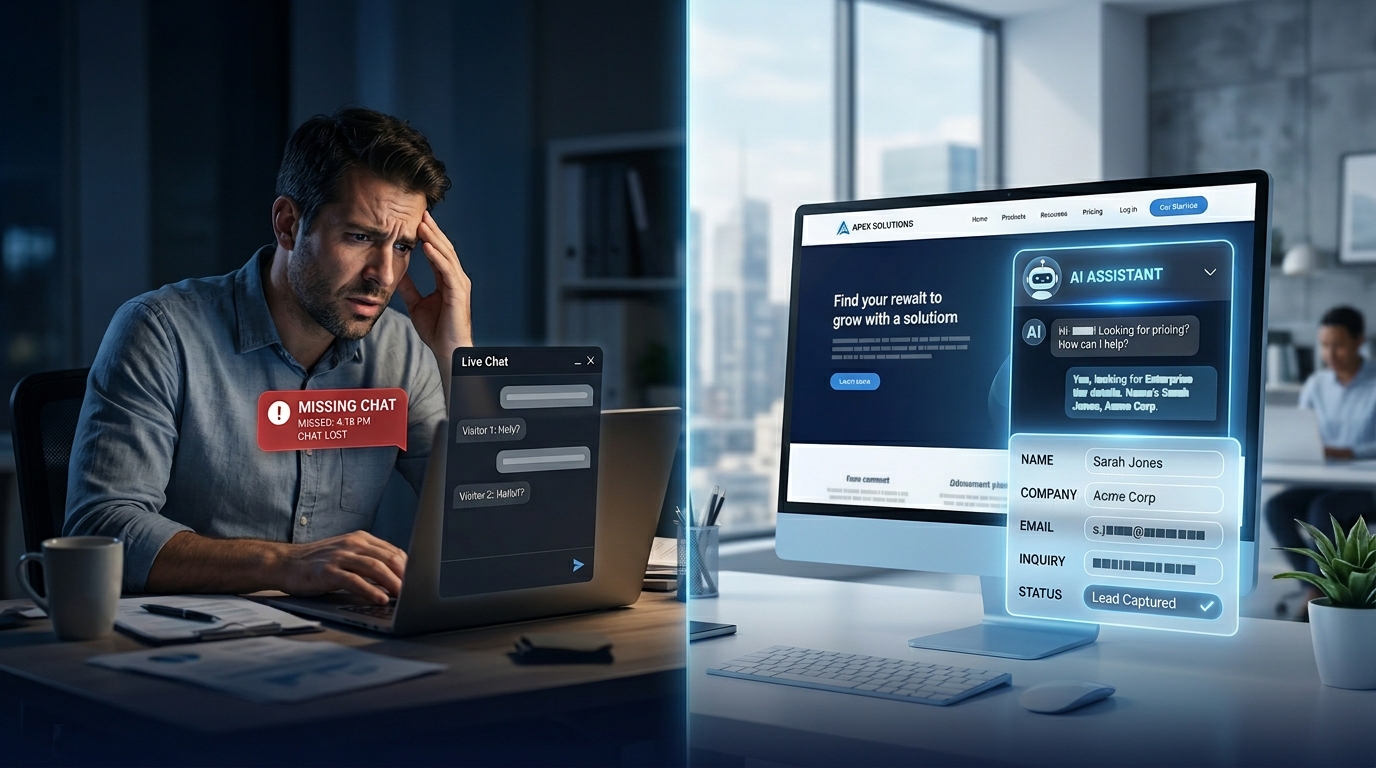
- With Live Chat: The visitor waits 5 minutes for a paralegal to notice the notification. By the time the paralegal replies, the visitor has already Googled another lawyer.
- With an AI Assistant: The AI instantly replies: “Yes, we specialize in personal injury cases. I can have an attorney review your situation. Could you briefly describe what happened, and provide your phone number?”
The AI secured the lead before a human could even open the chat window.
The Hybrid Approach: AI as the First Touchpoint
The most successful implementation for small businesses is what we call the “Hybrid Handoff.” You do not have to choose between AI and human interaction; you just need to put them in the correct order.
The AI assistant handles the “First Touch.” It acts as the digital filter. It greets the visitor, answers the repetitive questions (Where are you located? Do you offer this service? What are your hours?), and captures the lead details.
Once the AI has collected the structured data—name, phone number, and a summary of the problem—it packages that information and emails it directly to the business owner or manager.
Then, the human takes over. The business owner calls the customer back or sends a personalized email. The human is doing what humans do best (building relationships and closing sales), while the AI does what software does best (instant responses and data collection).
Making the Transition
If you currently have a static contact form or a quiet, abandoned live chat widget on your site, transitioning to an AI assistant is one of the fastest ways to increase your website’s return on investment.
You do not need to hire extra staff. You do not need to leave a browser tab open all day listening for a “ding” notification. You simply let the software engage your traffic and deliver the inquiries straight to your inbox.
To see exactly how an AI assistant can be configured to replace traditional live chat and start capturing leads for your specific industry, review the Selvanto guide. By leveraging automation, you ensure that every single website visitor gets the attention they deserve, exactly when they need it.
FAQ
What is the main difference between live chat and an AI assistant?
Live chat requires a real human to sit at a computer and answer messages in real time. An AI assistant uses automation to answer questions and capture leads 24/7 without human intervention.
Is live chat bad for local businesses?
Not necessarily bad, but it is often impractical. Most local business owners do not have the time or dedicated staff to answer website chats instantly, which leads to slow responses and lost leads.
Can an AI assistant sound natural?
Yes. Modern AI assistants are trained on your specific business data, allowing them to provide helpful, conversational, and natural responses rather than robotic menus.
Do I need technical skills to replace my live chat with AI?
No. Most AI assistants designed for local businesses can be installed just as easily as a traditional live chat widget—usually by pasting a single line of code into your website.
What happens when the AI cannot answer a question?
A well-configured AI assistant will gracefully pivot to lead capture. It will ask for the visitor's contact details and send the complex question to your email so you can follow up personally.
Next step
If you want to see how an automated AI assistant can replace a quiet live chat widget, review the internal Selvanto guide.
Read about Selvanto